
Frequently asked questions
The questions we get asked most, answered straight.
In short
This page answers 40 of the questions we are asked most about roofing: how long jobs take, when a repair is enough and when a roof needs replacing, what scaffolding is needed, and how quotes work. If your question is not here, call or WhatsApp 07939 013870.
General questions
Which areas do you cover?
Weather Proof Roofing and Building Services covers Chester, Wrexham, Queensferry, Flint, Warrington, Ellesmere Port, the Wirral, Manchester, Stockport, St Helens and the surrounding areas, across Cheshire, North Wales, Merseyside and Greater Manchester. If you are not sure whether you are in range, call 07939 013870 and ask.
How do I get a quote?
Call or WhatsApp 07939 013870, email Weatherproofroofing2001@outlook.com, or use the quote form on the contact page, which opens WhatsApp with your details already written out. Sending a photo of the problem is the fastest way to get a useful answer, because a lot can be told from a clear picture of a roof.
Are you insured?
Yes. Weather Proof Roofing and Building Services carries a full insurance pack, including £200,000 of public liability cover. Every job is also guaranteed by the company, so if something is not right after we have left, we come back and put it right.
How big is your team?
There are 17 of us. That is enough to strip and re-cover a roof properly and keep the job moving, rather than it being fitted in around other work over several weeks, while still being a company you can reach on one number.
Do you charge for a quote?
Quotes are free and there is no obligation to go ahead. You get told what needs doing and what it will cost before any work starts.
Can you tell what is wrong from a photo?
Often yes, at least well enough to say whether it is a small repair or something bigger. A photo of the affected area plus one of the whole elevation is usually enough for an initial view, though anything serious still needs looking at properly.
Do you do emergency call-outs?
Active leaks are treated as urgent, because water sitting in a ceiling does far more damage than the fault that let it in. Call 07939 013870 and you will be told honestly how soon someone can get to you.
Will you tell me if I do not need the work?
Yes. If a roof has years left in it and only needs a repair, that is what you will be told. Selling someone a new roof they do not need is a short-term way to run a business.
Do you work on commercial buildings as well as houses?
Most of the work is domestic roofing and building, and commercial and landlord work is taken on too. Call with the details and you will get a straight answer on whether it is a job for us.
How do I know the work has been done properly?
Jobs get photographed as they go, so you can see the parts of the work you cannot get to yourself. Every photograph on this website is from a job carried out by Weather Proof Roofing and Building Services.
New roofs and re-roofing
Full strip and re-cover in slate or tile, with new felt and battens. Read more about new roofs and re-roofing.
How long does a new roof take?
On a standard semi-detached house a full re-roof is usually a few days on site once scaffolding is up, and longer on larger or more complicated roofs. Weather is the main thing that moves the date, because a stripped roof cannot be left open in heavy rain.
Do I need scaffolding for a re-roof?
Yes. A full strip and re-cover cannot be done safely off ladders, and scaffolding is needed both for the people working and to stop material falling. The cost of it should be in your quote rather than added on later.
Slate or tile, which should I choose?
It usually comes down to what is already on the house and what the rest of the street has, because a roof that matches looks right and keeps the property saleable. Natural slate lasts longest and suits period property; concrete and clay tiles cost less and suit most modern housing.
Can you re-roof in winter?
Yes, roofs are replaced all year round. Work is planned around the forecast and the roof is never left open overnight, so a wet spell can push the finish date back a little.
Do I need planning permission to replace a roof?
Replacing a roof with a similar covering is normally treated as maintenance and does not need planning permission. It is different if the property is listed or in a conservation area, or if you are changing the roof shape or the material significantly, so check with the council first.
Roof repairs
Slipped tiles, leaks, valleys and flashings put right before they get worse. Read more about roof repairs.
How quickly can you look at a leak?
Call or send a photo on WhatsApp to 07939 013870 and we will tell you how soon we can get to you. Active leaks in wet weather are treated as urgent, because water sitting in a ceiling causes far more damage than the original fault.
Can you repair a roof in the rain?
A temporary cover can usually go on straight away to stop water getting in, but permanent work such as bedding mortar or dressing lead needs dry conditions to be done properly.
Is it worth repairing an old roof?
If the covering is sound and the problem is in one area, a repair is usually much better value. Once slates are slipping in several different places and the felt underneath has broken down, repeated repairs cost more over a few years than replacing the roof once.
Do you find the leak before quoting?
Yes. Quoting for a roof leak without establishing where the water is actually getting in is guesswork, and it is how people end up paying for work that does not fix the problem.
Why does my roof only leak in heavy or driven rain?
That usually points to a fault that only lets water past at a certain angle or volume, such as a gap under a flashing, a hairline crack in a tile, or a valley that overtops when it fills. It is a real fault and it will get worse, even though the roof seems fine most of the time.
Chimney repairs and repointing
Repointing, re-flaunching, new pots and cowls, or a full rebuild. Read more about chimney repairs and repointing.
Do I need to repair a chimney I no longer use?
Yes. A disused stack still has to keep water out of the house, and it is still masonry sitting high above a garden or footpath. Capping it and keeping the pointing sound is far cheaper than dealing with damp or a collapse.
What is chimney flaunching?
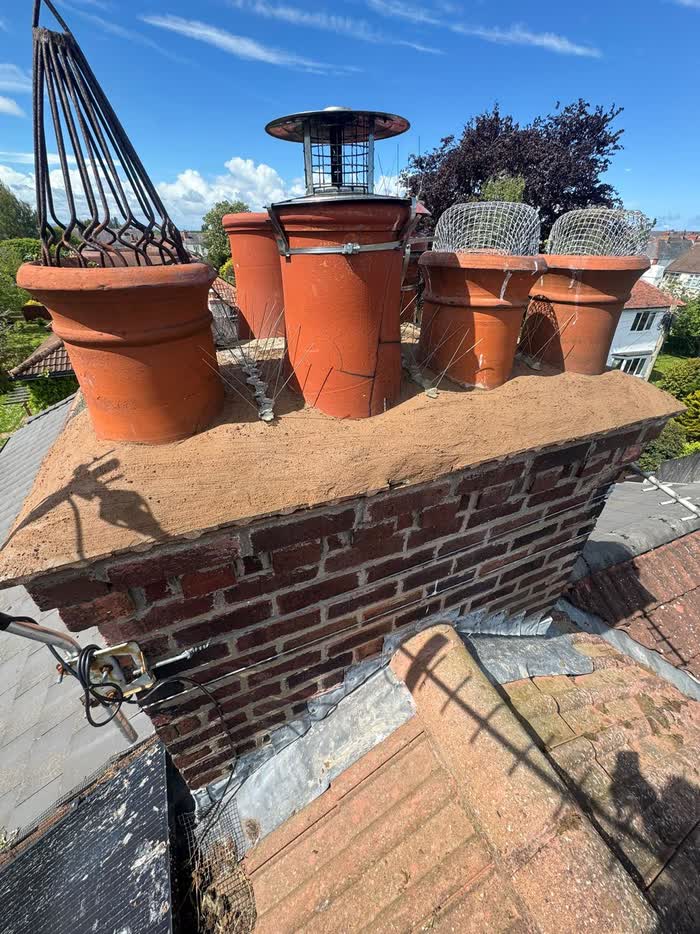
Flaunching is the sloped bed of mortar on top of the stack that holds the pots in place and sheds rainwater off the top. When it cracks, water runs straight down into the brickwork, which is why it is one of the first things to check on a damp chimney.
Should I remove the chimney instead of repairing it?
Taking a stack down below roof level and covering over is sometimes sensible on a chimney that is no longer used and badly decayed. It changes how the house looks and can affect ventilation to old flues, so it is worth talking through both options first.
Why is damp showing on my chimney breast?
Almost always water getting into the stack from above, through washed-out pointing, cracked flaunching or failed flashing, then tracking down inside the brickwork. Treating the wall inside does nothing while water is still getting in at the top.
Do you need scaffolding for chimney work?
Usually yes. Anything beyond a quick look needs a safe platform at the stack, and repointing or rebuilding certainly does. Occasionally a chimney can be reached from a tower or a roof ladder on a shallow pitch.
Ridge and verge work
Ridge tiles re-bedded or dry fixed, and verges made secure against the wind. Read more about ridge and verge work.
What is a dry ridge system?
A dry ridge system fixes each ridge tile down mechanically with clips, screws and a ventilated roll, instead of bedding it in mortar. It cannot crack and wash out the way mortar does, it lets the roof breathe, and it is what most new roofs are built with now.
Is dry ridge better than mortar?
For durability, yes, which is why it is standard on new build. Mortar still has its place on period property and in conservation areas where the look matters, and a well-bedded ridge in good mortar will last a long time.
How often does ridge mortar need replacing?
Bedded ridge mortar typically needs attention somewhere between ten and twenty years, depending on how exposed the roof is and how well it was mixed and pointed in the first place. Coastal and hilltop properties get through it faster.
Can you just re-bed the loose ridge tiles?
It can be done, but on a run where the mortar is all the same age you tend to be back doing the next section before long. Doing the full run at once usually works out better value once access is paid for.
What is a dry verge?
Dry verge units are interlocking caps that fit over the tile ends along the gable edge and screw down, replacing the mortar that used to seal that edge. They stop wind getting under the tiles and keep birds and rodents out.
Guttering, fascias and soffits
Gutters, downpipes, fascias and soffits replaced or cleared out. Read more about guttering, fascias and soffits.
How often should gutters be cleared?
Once a year is enough for most houses, and twice a year is worth it if you have trees overhanging the roof. The clear-out is best done in late autumn once the leaves are down.
Can you replace guttering without scaffolding?
Often yes. On a standard two-storey house guttering can usually be replaced from a tower or ladders where access allows. Higher or awkward elevations need a proper platform.
Should I replace fascias at the same time as the gutter?
If the boards behind the gutter are rotten, yes. Fixing a new gutter to a soft fascia means the brackets have nothing solid to hold, and you end up paying twice when the run starts sagging again.
What causes gutters to overflow even when they are clear?
Usually the fall is wrong, so water sits in the run instead of moving to the downpipe, or the gutter is too small for the roof area feeding it. Both show up in heavy rain and neither is fixed by clearing.
Do you clear gutters as a standalone job?
Yes. It is worth doing on its own, and it costs a lot less than dealing with a damp wall after a winter of overflowing gutters.
Building work and brickwork
Brickwork, pointing and general building work by the same team. Read more about building work and brickwork.
Do you take on building work without roofing?
Yes. Repointing, brickwork repairs and general building work can be booked on their own, they do not have to be part of a roofing job.
Why is my wall damp when the roof is fine?
Driven rain gets through washed-out pointing and cracked render just as easily as it gets past a slipped tile, particularly on the side of the house facing the prevailing weather. It shows up as a damp patch that comes and goes with the wind direction.
What is repointing?
Repointing means raking out the old failed mortar between the bricks to a decent depth and filling the joints with fresh mortar. Skimming a thin layer over failed pointing looks fine for a year and then falls off.
Can brickwork be done at the same time as the roof?
It is the sensible way to do it. Scaffolding is often the single biggest line on a quote, so getting the brickwork done while the access is already there saves paying for it twice.
Do you match existing brick and mortar?
We match as closely as the available material allows. Exact matches on old brick are not always possible, so colour and joint style are chosen to make repairs as unobtrusive as they can be.
Still not sure?
Call 07939 013870 or send a photo on WhatsApp and you will get a straight answer.